Showing posts with label aging in place. Show all posts

Wednesday, May 10, 2017

How a Smart Home Empowers People with Disabilities

Via http://www.nbcnews.com/tech/tech-news/how-smart-home-empowers-people-disabilities-n756731
Todd Stabelfeldt couldn't wait to marry his tall, beautiful, blonde wife Karen four years ago. But he was adamant that he didn't want her taking care of him. 
"A spouse should be your spouse. Your lover and your friend. Not a free caregiver," said Stabelfeldt, 38. 
Stabelfeldt is a complete quadriplegic with no movement below his shoulders, but he takes every opportunity he can to find independence — including in his marriage to Karen, 48. 
 Smart Homes Are Game Changer for People With Disabilities 3:59
"With being a husband and a dad, you just want to be able to provide and do what you can," said Stabelfeldt, who has two step sons, three dogs and one cat (he likes to remind his family that he'd rather they get rid of the latter). "Even though in certain areas, at least physically speaking, you can't really move much," he said. 
Stabelfeldt's cousin accidentally shot him in the jaw when he was eight years old, severing his spinal cord. 
"It's funny after 30 years, you still want to cry when you talk about getting shot," he said with a sigh. 
But he doesn't spend time feeling sorry for himself. In fact, he spends most of his time running his IT consulting business from his home office, helping his wife around the house when she's not at work, and building his charity, the TSF Foundation, to help other people in wheelchairs. 
And it's all thanks to new smart home and assistive technology like Apple's "HomeKit." 

A Smarter Home 

While advances in personal technology continue at a rapid pace, at times their designers seem to forget about the population that could perhaps benefit from it the most. Stabelfeldt says just the ability to charge a phone with a wheelchair didn't even exist until a few years ago. 
But features like Apple's "Home" app allow Stabelfeldt to control a variety of smart accessories in his house — from door locks and window shades, to lights and his garage door. The best part for Stabelfeldt? He can command Apple's intelligent digital assistant Siri to work it all. 
Todd Stabelfeldt is a quadriplegic with no movement below his shoulders, but he takes every opportunity he can to find independence — including in his marriage to Karen, 48. Chiara Sottile
"I use voice recognition on my iPhone, pretty much every day all day," he said, noting he sends more than 100 texts a day and averages a phone call every six minutes. 
Using external switches and voice command, Stabelfeldt can navigate his phone and control his smart home from his wheelchair. 
Apple's "Switch Control" allows Stabelfeldt and people with limited mobility to navigate sequentially through items on a device's screen using Bluetooth-enabled switch hardware — controllable by the mouth, for example. "Between Siri and Switch Control, I can use my phone just as good as anyone with 10 working fingers and hands," he said. 

A Game Changer 

"We put a lot of time and effort into making sure our products are as accessible as possible for all users," said Apple's Sarah Herrlinger. She has worked at Apple for nearly 14 years and is their Senior Manager of accessibility policy and initiatives. 
"For some people, doing something like turning on your lights or opening a blind or changing your thermostat might be seen as a convenience, but for others, that represents empowerment, and independence, and dignity," she told NBC News. 
Stabelfeldt calls this technology a game changer: "I never thought I'd have the opportunity to be in love. To be married. To have children. To have dogs." 
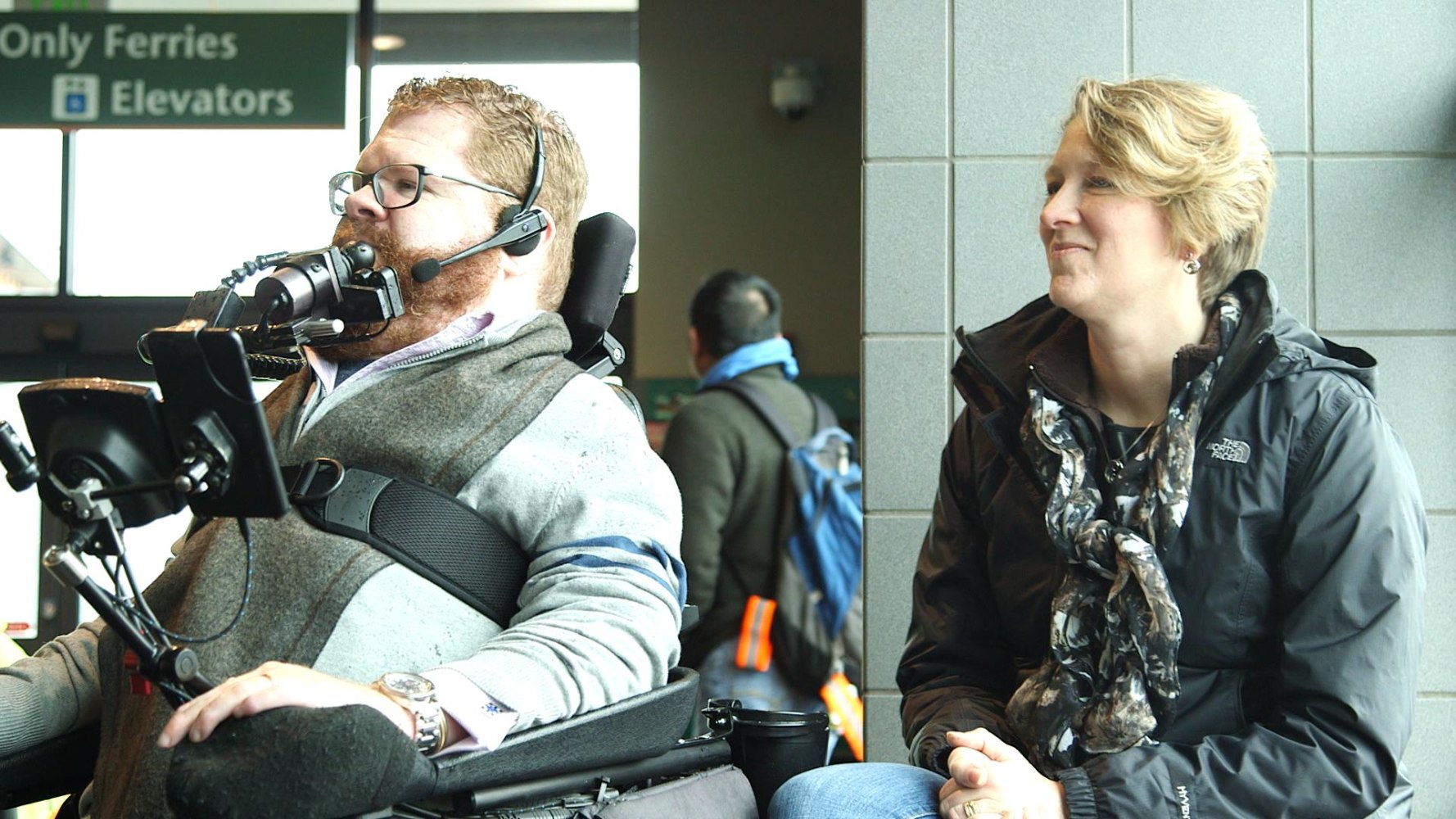
"You can be who you want to be. This technology just allows you to be you in your story. And that's pretty awesome," said quadriplegic Todd Stabelfeldt. Chiara Sottile
Todd can use his iPhone to select different accessories in various rooms in his very smart home, which he calls the "Quadthedral" in his typical wry humor. He can even create customized "scenes" to trigger a sequence of connected devices to perform a task in tandem. 
"Hey Siri, arriving home," said Stabelfeldt, on a recent trip home from a ferry ride. "Home sweet automated home," cooed the familiar voice of Siri — perched next to the wheelchair's control screen. And with that, he can disarm his home's security alarm, open the garage door, and turn on lights. 
Stabelfeldt monitors his home security, can let a delivery person in or out, or open the door on demand. 
"When I'm cooking, I don't have to stop and do those functions. He can facilitate and do those," said wife Karen. "Technology has completely changed how Todd can operate and where he can function." 
"You can be an employer or an employee. You can be who you want to be and this technology just allows you to be you in your story. And that's pretty awesome," said Stabelfeldt. 

An Independent Love 

But it makes a difference in what might be considered small gestures, too. 
Before he could navigate his iPhone with voice control and Siri, it was Stabelfeldt's caregiver who used to receive his calls and text messages — even affectionate messages from Karen. The caregiver would then relay them to Todd. 
"We weren't in this romance just with us. We were sharing our romance with other people," he recalled. 
Now, the Stabelfeldts relish how they can take care of each other, with help from technology. 
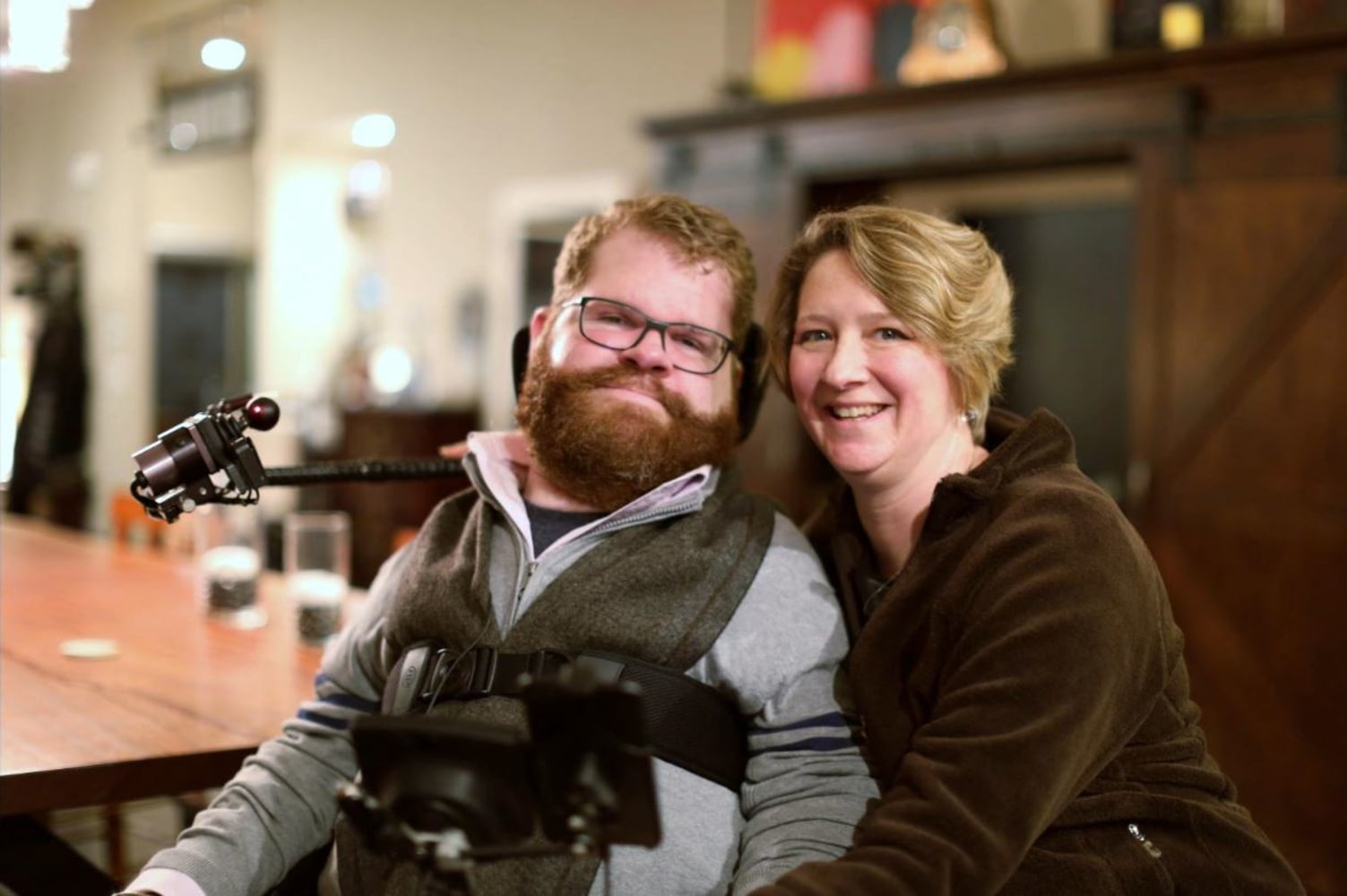
Todd and Karen Stabelfeldt Chiara Sottile
"[It] makes my heart swell, you know... there's just a certain sweetness that comes with being cared for," said Karen, leaning in towards her husband. "We appreciate each others' strengths. You know, we don't both have to be strong in the same area." 
Stabelfeldt says he is optimistic that the technology will continue to improve, adding more and more accessories to the devices he can connect into his smart home setup. He says he wishes all his smart accessories could be controlled with one app, since they can't all currently fall under the umbrella of Apple's Home app. 
"HomeKit and Switch Control and Siri have given me a lot of value and a lot of opportunities to demonstrate that I'm a quality man and I'm a man of integrity," Todd Stabelfeldt. "To get up every day and go to work: Everybody's valuable, everybody has worth, everybody should have the opportunity to demonstrate it."

Wednesday, March 22, 2017

Elderly And Disabled Assistive Technology Market To Surpass $26 Billion By 2024

The World Health Organization (WHO) estimates that 285 million people are visually impaired worldwide. 70 million people need a wheelchair. Another 360 million people globally have moderate to profound hearing loss. Globally, more than 1 billion people need one or more assistive products.

The global elderly and disabled assistive devices market was valued at $14 billion in 2015 and is expected to surpass $26 billion by 2024, according to Coherent Market Insights. It is a sizable market with an incredibly diverse set of needs. Many products have to be customized which is why 3D printing is an ideal way to study and solve some of it.


Photo from MatterHackers Envision the Future Design Challeng

MatterHackers, one of the largest 3D printing retailers in the U.S., wants to put a big dent in those numbers by encouraging inspiring, low-cost or free, assistive device models that people can 3D print or build from some other material. Officially, the “Envision The Future Design Challenge” is to create educational tactile models and assistive devices for the blind and visually impaired.

WHO defines assistive technology as any product that helps maintain or improve an individual function. Hearing aids, wheelchairs, eyeglasses, prostheses, pill organizers, and memory aids are all examples of assistive devices or products. You do not have to go far in 3D printing circles to find solutions or at least potential ideas to solve these sorts of problems or issues -- and I have written about many of them -- from custom insoles (orthotics) to hearing aids to haptic feedback in a glove (one of my very first posts over 5 years ago).
With an aging global population and a rise in noncommunicable diseases, more than 2 billion people will need at least 1 assistive product by 2050, with many older people needing 2 or more, according to a WHO assistive device fact sheet.

With an aging global population and a rise in noncommunicable diseases, more than 2 billion people will need at least 1 assistive product by 2050, with many older people needing 2 or more, according to a WHO assistive device fact sheet.
One of the more famous assistive device designs, not part of the MatterHackers design challenge, comes from the e-NABLE Community: the “Iron Man” video tells the story of Robert Downey Jr. giving an Ironman prosthetic hand to a child. Awesome video. That design was developed by the UCF Armory (University of Central Florida), led by Albert Manero, the Limbitless Arm was e-NABLE’s first myoelectric design. The Limbitless Arm is licensed under the Creative Commons-Attribution-Non-Commercial license. Success stories like these inspire more people to realize how accessible 3D technology is making incremental and exponential improvements possible -- that you might have an idea that could change the world for you or someone else.

Given that so many people have a need for assistive devices and products across a wide range; 3D printing is one of the best ways to approach the problems. If you look at an organization like Enabling The Future, that crowdsources the making of 3D printable prosthetic hands, a design challenge can provide new ideas and solutions that might not otherwise make it to market. Plus, it spreads the word and inspires more people, design-minded people, to consider how they might approach this massive market need and opportunity.
Additional resources:

Briefly, because everyone wants to know about prizes when there's a challenge like the Envision The Future Design Challenge, there are two categories: Youth (under 18) and Adults (18 and over). Each category will have 1st, 2nd, and 3rd place winners with prizes sponsored by LulzBot and MatterHackers. Youth grand prize is a Lulzbot Mini 3D Printer (don’t let the name fool you; it is a decent size printer). Adult grand prize is a Lulzbot TAZ 6 (larger print area than the Mini). Both grand prize categories also come with a MatterControl Touch T10 - 10.6" Standalone 3D Printer Controller – basically a tablet you can use to run a printer without needing a full computer. The challenge runs from March 20, 2017 through May 8, 2017 and the full details are here.


Coherent Market Insights produced the Elderly and Disabled Assistive Devices - Evolving from Luxury to Necessity report; a summary is available here.

Wednesday, March 15, 2017

Technology to Improve Seniors’ Lives

Technology to imrprove seniors' lives
Two concurrent trends—the shifting demographics toward an aging population and the emergence of dramatic new technologies—are converging to create an intensified focus on improving the quality of life for seniors.
“Outthink Aging,” a report from IBM and the Consumer Technology Association Foundation released in September 2016, outlines the challenges of meeting the needs of the aging population and addresses the potential for leveraging new technologies for seniors that will extend their independence while also helping them to  better manage everyday activities and connect more meaningfully with loved ones.
The demographic trends driving this need are global in nature and will intensify in the coming decades. By 2050, according to United Nations statistics cited in the report, more than one out of five people will be age 60 and older.
“Technology does not replace the human element, but it’s a tool that will enable the growing aging demographic and caregivers to better our lives as we age,” says Steve Ewell, executive director of the CTA Foundation.
The Consumer Technology Association, which represents more than 2,000 technology companies, launched the foundation in 2012 to focus on how technology can help older adults and people with disabilities. Its partnership with IBM, announced in January 2016, is a major step forward in fulfilling that mission. “New partnerships between industry, non-profits, academia, government, and the general public will form to accomplish these goals,” Ewell reports.

Independence with Technology

Research from AARP and others confirms that the vast majority of elders want to remain independent for as long as possible, and for many, this translates into a desire to remain in their homes. “Technology can be used to help people essentially augment their ability to age in place,” says Susann Keohane, Global Research Leader, Strategic Initiative on Aging at IBM.
From a caregiving perspective, technology allows caregivers to stay on top of their parent’s needs—for instance, with connected devices and ambient sensors that can help provide valuable information on how well someone is going about their day by monitoring changes in the environment around them.
“This is not meant as a replacement for human care,” Keohane stresses, “but as a means of providing more insightful information that will allow someone to better care for their loved one or their elder client.”
Technology also has the ability to identify signs that a transition to another type of living environment is warranted. “A lot of these major transitions that occur in life happen from an emotional standpoint—i.e., ‘Mom, I’m worried about you, you’re alone, what if something happens?” Keohane observes. “Technology allows you to get a more analytic view.”

Addressing Senior Concerns

“Outthink Aging” defines four essential aspects reflecting the core desires of an aging population as they relate to living an independent life:
  • Health: access to high-quality healthcare and services that encourage physical/cognitive health
  • Connection: staying connected with family, friends and the community
  • Security: protection against theft and financial fraud, while also having personal safety in the home
  • Dignity and independence: which includes striking a balance between the desire for privacy and the need for support
As a means of addressing those four issues, one area that’s getting attention is the Internet of Things—or IoT—which is a collective term to describe devices that are able to send and receive data. As an example, Ewell cites devices in the home that can be used to control lighting, the thermostat, and security through phone, voice control or another type of interaction.
“One of the exciting things about these technologies is that the are not necessarily being designed to address aging specifically; they’re general consumer technologies that happen to have features that can create greater independence for someone who’s older or has a disability,” Ewell explains.
One benefit of cognitive technology is the ability to help individuals stay secure, Ewell explains. “For instance, if someone wakes up in the middle of the night and they are worried—‘Did I close the garage door or lock the front door?’—these devices can control or confirm that it’s taken care of.”
Such technology also can be helpful for caregivers who need affirmation that everything is all right in the loved one’s home. However, Ewell cautions, “It needs to be done with the right degree of privacy, so that it’s really a benefit to the older adult and not just a matter of keeping watch.”
Combined with cognitive computing, IoT also can be useful in an assisted living setting. To gain more insights into this, IBM and the Avamere Family of Companies recently announced a six-month research study that will apply the power of IBM cognitive computing to improving eldercare at Avamere’s senior living and health centers. By analyzing data streaming from sensors, Avamere hopes to identify risks and gain insights with the goal of minimizing hospital readmission rates.

An Intriguing Future

As part of its continuing partnership, the CTA Foundation and IBM have undertaken a new joint initiative: self-driving transportation. Joining them in this endeavor is a third partner, Local Motors, which launched Olli in 2016 as the world’s first cognitive self-driving vehicle powered by IBM Watson technology. The partners are working together to crowd-source new cognitive technology solutions to support this initiative.
Concerns about driverless safety and accessibility are already being addressed. “Many of the vehicles developed today have a wide array of built-in sensors that enable the vehicles to be aware of challenges from other vehicles on the road,” Ewell reports. “These advanced sensors, and the fast reaction times of the vehicles, allow self-driving vehicles to be more likely to identify and avoid potential issues than human drivers.”
For an elderly population, Ewell observes that there may be opportunities to change the driver role into one of a concierge or assistant who can help with passengers’ specific needs.
This is just one of many intriguing technologies that have potential for improving older people’s lives. As Keohane observes, the challenges of aging come primarily from a loss of ability over time. “Those of us who are working on these issues have an accessibility background. We know how to make technology work for people who have disabilities. In the case of elders whose abilities are changing, we can help them with technology that meets them where they’re at in life.”

Wednesday, March 8, 2017

Older adults buddy up with Amazon’s Alexa

http://www.marketwatch.com/story/older-adults-buddy-up-with-amazons-alexa-2016-03-18


Amazon


When Willie Kate Friar wakes in the middle of the night, the octogenarian doesn’t have to turn on the lights or crane her neck to find out the time. She simply asks her digital assistant, who responds in a life-like voice.
“I’ve found Alexa is like a companion,” Friar said of Amazon Echo’s new voice-controlled assistant, a black cylinder called Alexa.

A Panama-based retiree who writes and lectures on cruise boats, Friar is recuperating from a recent fall and asks Alexa to play music during her physical therapy sessions. “The music lifts my spirits,” she said.

–– ADVERTISEMENT ––


Widely introduced last summer, Amazon’s AMZN, +0.47%   new wireless speaker has won praise from tech gurus for its invisible technology that responds to spoken commands and questions. Voice commands can prompt Alexa to do everything from playing music to adding items to an Amazon shopping list to answering questions and giving weather, traffic and news updates. (Think of the device as a way to connect to the Internet by speaking instead of typing.)
The device is also gaining support among disabled adults and the elderly. Among the more than 30,000 customer reviews on the Amazon website are those from caregivers for wheelchair-bound relatives who love the control that Alexa gives them over their environment, and also from family members of older adults who enjoy Alexa’s companionship and help.
Alexa wasn’t designed for older adults, and experts say that might be part of its appeal with that demographic. The device avoids the bland aesthetic that has traditionally characterized assistive devices, which turns off consumers who don’t self-identify as old — that is, pretty much everyone. 
“They were smart to make it look like a cylinder,” said Tony Gentry, an occupational therapist and director of the Assistive Technology for Cognition Laboratory at Virginia Commonwealth University. “People can project their own imagination onto it.”
Promise
Gentry recognizes Alexa’s promise to alleviate loneliness in older adults and plans to test the device with some of his elderly clients soon. Robots “don’t have to do much to provide a sense of companionship,” he said, noting how people are quick to anthropomorphize their Roomba robotic vacuum cleaners.
Among older adults, a sense of companionship can mean the difference between sickness and health. Research has shown how loneliness causes people to become physically ill. 
Friar lives alone. She received her Alexa as a gift during a visit to the U.S. last Christmas. She brought the device back to Panama and connected it to WiFi herself. “People should recognize how easy it is to set up,” she said. 
To set up Alexa, users need an electrical outlet and a Wifi connection. The latter can come from a desktop computer, smartphone or tablet. Friar owns an Amazon Fire smartphone, along with four computers, two tablets and two Kindle e-readers. She’s unusually connected for her age: only 30% of adults age 71 and over who are online own a smartphone, and of those just a tiny fraction use the phone intensively, according to Forrester Research, a market research firm.
Ron Grant, 63, owns a smartphone, and he’s eager to buy an Alexa, too. “It looks like it’d be fun and handy,” said Grant, of Moore, Okla. who was diagnosed with early-onset Alzheimer’s disease at age 55. For now, he’s holding off buying one, hoping Amazon will lower the device’s $179.99 price tag. 
Grant enjoys listening to music and would welcome the ease of asking Alexa to play his favorite tunes. He sometimes has hand tremors and would also like a way to turn on the television and adjust the channels and volume without fumbling with the remote control. Alexa can be programed to turn the TV on and off.
Limitations
For those with dementia, Alexa can tell the date and time, as well as respond to questions whose answers might have slipped from memory, such as “When was Ronald Reagan president?”
Yet given the devastating progression of Alzheimer’s disease and other dementias, experts say Alexa’s usefulness can only last so long. The device will eventually become confusing and possibly anxiety-provoking as people forget how to use it. “The ability to say, ‘what is the traffic like?’ and ‘buy me some paper towels’ is valuable, but it’s a short window,” said Niles Frantz, a spokesman for the Alzheimer’s Association.
Another limitation when it comes to older adults is that Alexa cannot currently dial 9-1-1, a capability that online reviewers have requested. With that functionality, the device could replace on-call emergency buttons, which many older adults eschew. A spokeswoman for Amazon confirmed that Alexa cannot currently make calls and declined to say whether that functionality may be added. 
Alexa does have an Ask My Buddy function to help users in an emergency. Developed by one of the third-party firms that Amazon has invited to create “skills” for Alexa, this function can send phone calls or text messages to up to five contacts. A user would say, “Alexa, ask my buddy Bob to send help” and Bob would get an alert to check in on his friend. 
For her part, Friar would like Alexa to learn Spanish. An Amazon spokeswoman confirmed that Alexa speaks only English today but stressed that the device is “always getting smarter” as the company adds new functionality on a regular basis. 
When Alexa can’t yet say “hola,” Friar enjoys showing the device off to her local friends: “I think Amazon should make a big effort to market it to older adults.”

Friday, April 26, 2013

Aging in Place: The ‘In’ Market


“Aging in Place” is a phrase that I come across on a regular basis and appears to be the ‘in’ phrase right now for the 55+ segment of the population. What does it mean to you? How would you define it? According to Wikipedia, it is: “The ability to live in one’s own home and community safely, independently, and comfortably, regardless of age, income, or ability level.” If one is a younger senior or a baby boomer (one born between 1946-1964) there is still time to make this decision, to save money and to plan for the ‘golden years’ although many may continue to work beyond the typical retirement age of 65-67.

From everything I have heard and read, most adults would like to stay in their own home until they are no longer able or until they die, but is this realistic? Is your current home modified for future needs, are renovations needed or are you in the market for an already modified home? An existing home needs to have a bedroom, bathroom, kitchen and laundry room on the main floor. The market for purchasing a new home or an already modified one: all is one level as in ground floor only with the main features of the house accommodating the needs of an older senior or one with a physical disability; wider doorways, no entranceway stairs, walk in showers with a built-in bench, pull-down or adjustable shower head, non-slippery floor surfaces throughout the home, lower cabinets, easy and accessible closet/storage space, etc.

Home maintenance and finances will be huge factors in the decision process as well. Are amenities close by, public or alternative transportation, medical care, family support, private support/services, socialization opportunities, and most importantly is it affordable? It could cost quite a sum of money to renovate/modify an existing house. Does it make more sense to buy a house that is already modified whether it is a stand alone house or one that is part of a community? These are all questions to consider before making a decision. What this means is a shift from a youth driven market to the aging market in terms of housing.

Louis Tennenbaum, Carpenter/Former Contractor says it best in his article Why You Should Remodel to ‘Age in Place’ Now on Next Avenue:
If boomers think about aging in place at all, we usually regard it as something we can put off until much later in life. Or to be more accurate, it’s something we hope we can put off until much later. That’s because we associate these kinds of modifications with growing old, which doesn’t sound like much fun.
There’s a better way to think about it, though: Aging in place is about creating a home so beautiful, comfortable and expressive of your personality that you never want to leave. We can’t fight aging, but we can take steps to make our house the place we want it to be.
A reframing of aging itself is needed in order for the phrase ‘aging in place’ to become acceptable. Aging is inevitable, but factors of health, well-being both physical and mental, social opportunities, accessibility to needed and necessary support/services/healthcare and finances all play a part in how one ages.

I also came across the Kendall Northern Ohio Blog which has an article on: Aging in Place: Look for Universal Design Features which lists some very practical advice for those looking to relocate into a home that has not been designed in the ‘aging in place’ style, but instead already exists and has universal features built-in that will accommodate someone with a physical disability or a senior with physical/health limitations.
  • No-Step Entry
  • French Doors
  • Wide Interior Doors
  • Open Space
  • Downstairs Bathroom/Bedroom
  • Low Shelving and Sinks
  • Smooth Shower Entry
  • East Turn Faucets/Fixtures.
  • Easy Twist Doorknobs
  • Grab Bars
Baby-boomers do not want to age in a typical senior residence or nursing home that current ‘older’ seniors have chosen or been placed in due to health conditions, diseases, physical limitations or cognitive disorders. The larger a cohort is, the more influence it can have on the market and this is already being seen. Baby-boomers are well-educated, demanding and research information as needed to expand their knowledge. Demands will be met or businesses lose out financially. It will be interesting to watch this market grow.

Written by Victoria Brewster, MSW
SJS Staff Writer

Thursday, March 14, 2013

AT&T's mobile personal emergency response system will provide fall detection for seniors and allow them to connect with caregivers using machine-to-machine technology

AT&T is developing a mobile personal emergency response system (MPERS) to help elderly people when they fall. The platform will use GPS functionality and machine-to-machine (M2M) technology to connect patients remotely to medical professionals at monitoring centers.
 

The company is collaborating with Valued Relationships, Inc. (VRI) and Numera on the service. VRI provides telehealth monitoring and medical alert systems to seniors, the chronically ill and patients with disabilities. Numera manufactures a Libris MPERS device that works with monitoring software to remotely manage two-way voice, automatically detect falls and track seniors' location.

"With the MPERS mobility solution AT&T is developing, older people will be able to live independently but know that they are only seconds away from assistance if the need arises," Dr. Geeta Nayyar, AT&T's chief medical information officer, said in a statement.

AT&T will offer the MPERS as a managed service as well as provide wireless connectivity and sales, marketing and customer support.

Announced on March 4, the MPERS use two-way wireless voice communication to allow patients and caregivers to connect using the MPERS. The platform is designed for elderly people with disabilities, those prone to falls and people that need emergency connectivity to caregivers while still living independently.

One out of three adults ages 65 and older fall each year, according to the Centers for Disease Control and Prevention, and 20 to 30 percent of falls result in moderate to severe injuries, including lacerations, hip fractures or head traumas.

The wireless company will market the service to nursing agencies, day care services and home health care providers.

AT&T demonstrated the MPERS platform in New Orleans at the HIMSS13 conference, organized by the Healthcare Information and Management Systems Society (HIMSS).

The MPERS device's GPS functionality will report on a patient's location every 3 to 5 minutes, said Eleanor Chye, assistant vice president for AT&T ForHealth, told eWEEK in an email.

"Should a person fall while wearing the sensor, built-in technology will detect it and automatically alert a monitoring call center," said Chye. "A professional from the call monitoring center will reach out to the individual through instant two-way wireless voice communication on AT&T's network."

Several wireless devices on the market can help seniors when they fall. They include iLoc Technologies' TriLoc Personal Locator Device and the Philips Lifeline GoSafe MPERS.

"When falls and acute medical events (such as heart attacks or strokes) occur, each second that passes matters," said Chye. "Individuals need to be able to immediately alert emergency services and their caregivers when these critical moments happen."

AT&T also worked with VRI to develop a remote-monitoring platform (RPM), which went to market in September 2012. The RPM allows nurses at VRI's telemonitoring facility to monitor patients' vital data, including blood pressure, weight and pulse.

"Having access to additional data through the end-to-end RPM solution, such as a patient's blood sugar levels, weight, and blood pressure, could give providers invaluable information about what triggered the fall," Chye said.

The two platforms could work together to "help provide a clearer picture of what's really going on with a patient when they are outside the four walls of a hospital," said Chye.

Brian T. Horowitz is a freelance technology and health writer as well as a copy editor. Brian has worked on the tech beat since 1996 and covered health care IT and rugged mobile computing for eWEEK since 2010. He has contributed to more than 20 publications, including Computer Shopper, Fast Company, FOXNews.com, More, NYSE Magazine, Parents, ScientificAmerican.com, USA Weekend and Womansday.com, as well as other consumer and trade publications. Brian holds a B.A. from Hofstra University in New York.Follow him on Twitter: @bthorowitz